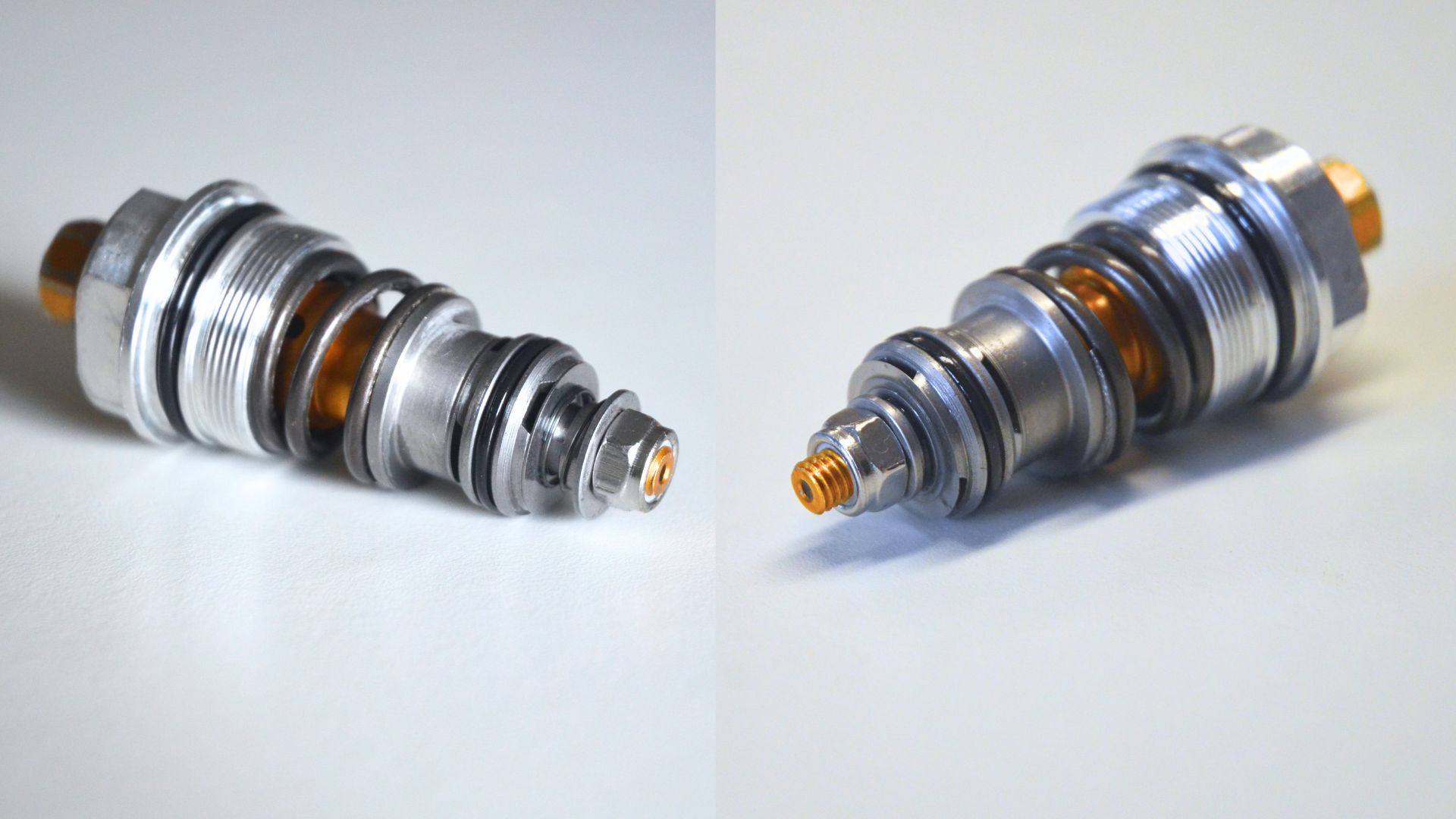
Shimming the Adjuster Piston: A Closer Look at Refill Damping
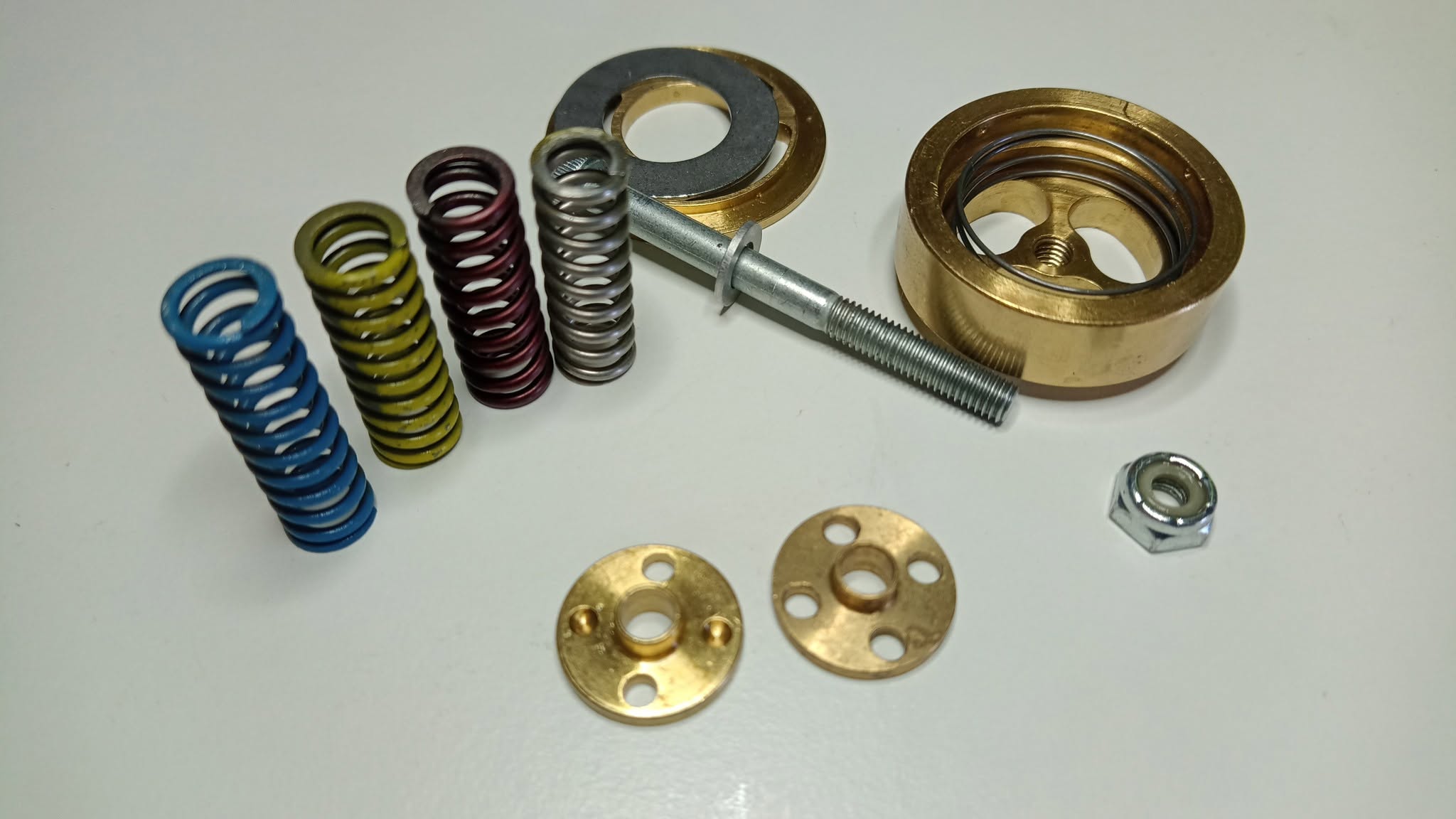
I’ve seen after-market shock compression adjusters advertised where instead of having a check-plate to refill the shock on the rebound stroke, a shim stack has been added to generate damping on the rebound stroke.
Fortunately, the school’s shock collection includes one that could be tested both ways: with a standard check-plate and with a shim stack on the adjuster piston. So rather than argue about it in theory, we can look at what actually happens.
Isolating the Adjuster
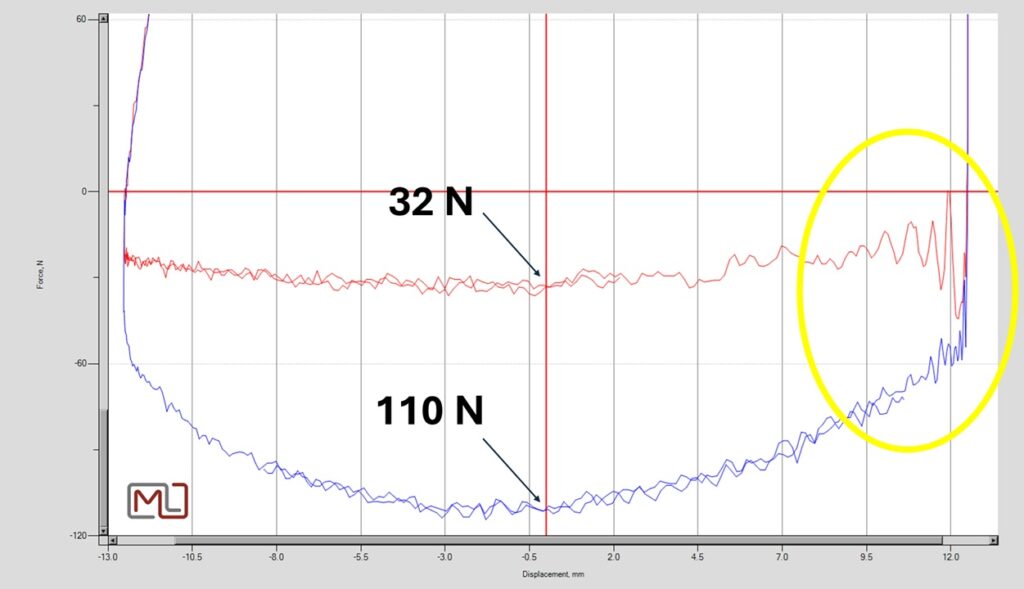
To get a clean picture of what the adjuster piston is doing, the shims were removed from the main piston. This isolates the adjuster’s behavior so we’re not looking at a combined effect. The shock was then tested at 0.5 m/s, and all the Force/Displacement data shown is raw and unfiltered, with no smoothing applied.
What the Data Shows
Check-Plate (red trace)
The check-plate lifts at around 45N, shows a brief flutter, then settles at a steady 32N as the shaft moves. The plate opens quickly, gets out of the way, and lets fluid refill the body with minimal resistance. That’s the whole point of a check-plate: fast, low-restriction refill.
Shim Stack (blue trace)
The shim stack lifts at 54N, a slightly higher opening force, it also has a small flutter, then does something the check-plate doesn’t: it builds force progressively as the velocity increases, reaching 110N at 0.5 m/s, showing active damping on the refill stroke.
Translating Force into Pressure
The adjuster piston has a 14mm rod diameter. Using P = F/A:
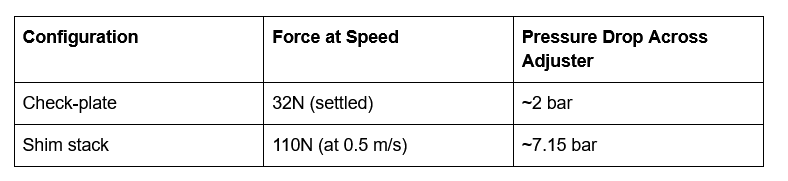
Now to put that in context. The shock is statically balanced at 10.7 bar at mid-stroke with all chambers equalised.
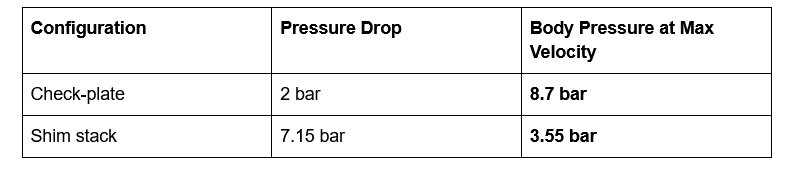
These calculations don’t account for mechanical friction or stiction, so they’re not exact, but the relative picture is clear enough.
The Cavitation Risk
This is where the shimmed adjuster could get problematic.
With a check-plate, the body pressure at maximum velocity sits at 8.7 bar. That’s a comfortable margin above the charge pressure, cavitation is not a concern.
With a shim stack, you’re at 3.55 bar. You’re eating into the charge pressure headroom. Push the velocity higher, add heat, and you could find yourself approaching conditions where the oil cavitates, with the associated force spikes, noise, and potential for damage.
So: Shim Stack or Check-Plate?
It depends what you’re trying to achieve and what you’re willing to risk.
A check-plate does its job: opens fast, minimal pressure drop, maximum margin against cavitation. Refill damping comes from the main piston, where you have far more control over the shim stack geometry, clamp load, and progressive characteristics. The infinite tuning possibilities are there on the main piston.
A shimmed adjuster piston adds another layer of refill resistance, a relatively crude one compared to a purpose-designed main piston shim stack, and does so at the cost of body pressure. It may suit a specific application or be a pragmatic solution in certain configurations, but it’s not a free lunch.
The data makes the trade-off visible. Whether it’s a trade-off worth making is a tuning decision