Shock Bladders
There are some laws of physics that just can’t be ignored when looking at bladders.
When Erich Konrad and Eduard Tschunkur first copolymerised acrylonitrile and butadiene, I doubt they envisaged that, a hundred years later, middle-aged men would be sat in their Mum’s attic, in their underpants, arguing with their contemporaries over an electronic box.
That argument — bladders versus IFPs — isn’t what this post is about. But the reason it gets so heated is that most people on both sides are either unaware of, or choosing to ignore, the physics that was settled centuries ago. And the physics doesn’t care about forum consensus.
The Problem Nobody Wants to Admit
Nitrogen permeates through bladders. Not might. Does.
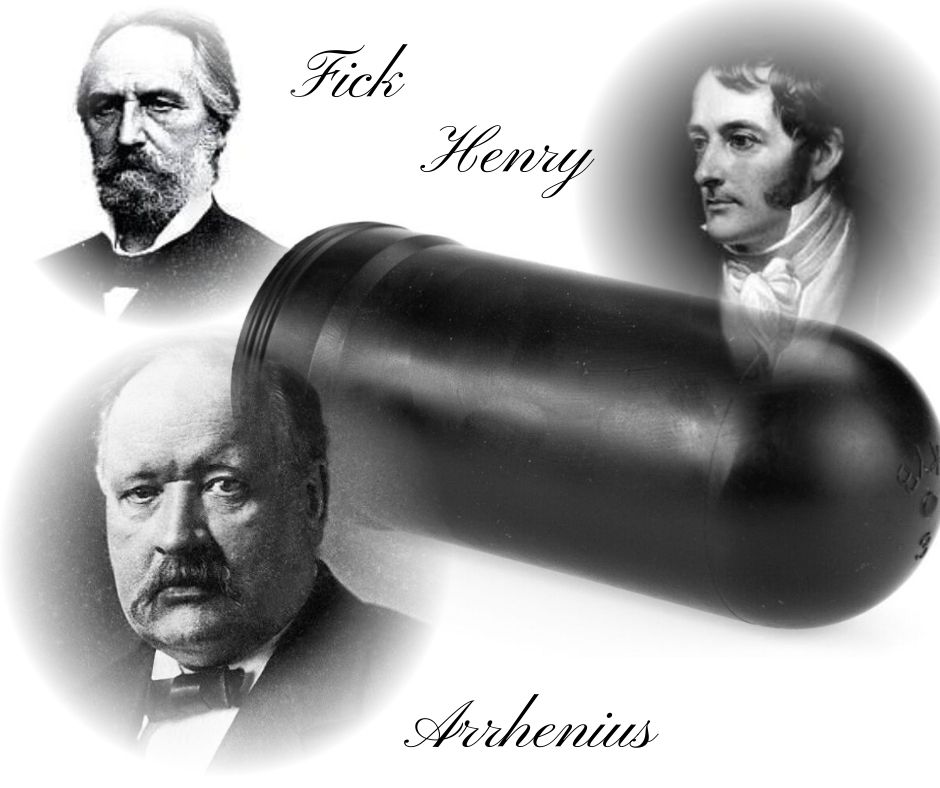
If you’ve been told otherwise, the person telling you that is asking you to ignore the work of three physicists who between them mapped this out between 1803 and the 1880s. The mechanism is well understood, the rate is predictable, and there are ways to slow it — but not stop it.
Here’s how it actually works.
Henry’s Law (1803), can be applied to polymers as well as liquids. Nitrogen dissolves into the wall of the bladder. It quickly reaches saturation as the wall is thin and the volume is limited; it’s more of a temporary reservoir.
The amount of saturation is proportional to the pressure.
Fick’s Law (1855). Dissolved nitrogen moves from high saturation to low saturation. There’s a high concentration of nitrogen inside the bladder and a low concentration outside, so the nitrogen diffuses through the bladder.
The rate is proportional to the surface area, the concentration gradient and the membrane thickness.
In the 1880’s Arrhenius quantified the relationship between reaction rate and temperature, which explains why the diffusion rate happens quicker with temperature.
Permeability=”Solubility (Henry)”×”Diffusivity (Fick)”
Arrhenius then describes how permeability changes with temperature. When the temperature rises, more nitrogen dissolves into NBR, the nitrogen diffuses faster and the total permeation increases significantly.
This isn’t theoretical — it’s measurable, predictable, and happening in every bladder shock currently in service.
What Manufacturers Do About It
Bladder manufacturers have a couple of tools to slow permeation. None of them eliminate it.
Fillers
Fillers such as carbon black dispersed through the rubber can block and twist the path the nitrogen takes, slowing the permeation, however it also stiffens the rubber.
Silica could also be used instead of carbon black to slow the rate of dispersion, but it’s less effective.
Kaolin can be used as a filler, it forces the gas molecules to take a zig-zag path slowing permeation.
ACN Content
The acrylonitrile (ACN) content also reduces the permeation through the bladder. Nitrile groups attract each other and pack the polymer chains closer. This reduces free volume inside the rubber, so the nitrogen has fewer and smaller gaps to move through.
The ACN content effects the rate of permeation:
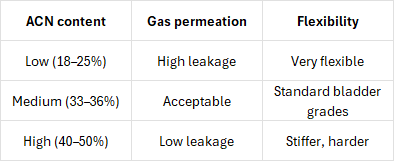
Low ACN (18–25%) Excellent flexibility, but nitrogen leaks too fast.
High ACN (40–50%) Very good gas retention but rubber becomes stiff, poor low-temperature performance, increased risk of fatigue or cracking.
Medium ACN (33–36%) Acceptable nitrogen retention, acceptable flexibility and fatigue life, works across a wide temperature and pressure range.
Where Forum Arguments Go Wrong
The bladder versus IFP debate is largely a distraction from a simpler point: whichever separation system you’re using, understanding its failure modes is what matters. Arguing that nitrogen doesn’t permeate through bladders requires ignoring Henry, Fick, and Arrhenius. That’s not a position — it’s a preference.
The technicians who service these systems correctly aren’t the ones with the strongest opinions. They’re the ones who understand the physics well enough to know what to check, when to check it, and why.
Gas charge management, bladder condition assessment, and the practical implications of permeation over time are part of the Suspension School Shock Servicing and Master Technician Courses. If you service bladder shocks and need to understand the underlying physics, we can assist.
Details on the courses can be found at: