The PDS Shock: Nearly 40 Years of Link-less Rear Suspension
PDS. Progressive Damping System. No linkage, no rising-rate geometry, just a shock mounted directly between the frame and the swinging arm, doing all the progressive work itself, internally.
It’s one of those pieces of engineering that riders either swear by or swear at. Here’s how it came to be, and how it actually works.
Where it started
The idea of putting the “rising rate” inside the shock rather than in an external linkage isn’t new. The lineage, as best it can be traced, starts with a 1987 patent from British engineer Josiah Pitt for a dual-piston shock design, building the progression into the damper itself rather than relying on link geometry.
Öhlins picked up the concept and refined it, filing its own patent in 1996. That design found its way onto a motorcycle the following year: the 1997 KTM Jackpiner, a limited-edition off-road bike built to mark the 30th anniversary of the first KTM/Penton sold in America. Only 133 were made, but the bike’s significance had nothing to do with its rarity. It was the first KTM built with no rear linkage at all. Inside, a needle engaged a twin-piston arrangement that progressively increased damping as the shock moved through its stroke.
Within a year, KTM had rolled the system out across most of its off-road range — but with WP shocks instead of Öhlins ones. Exactly how the technology moved from Öhlins to WP is the kind of detail that’s probably better filled in by people who were around the factory at the time, I can’t find anything written down publicly. What’s clear is that PDS quickly became KTM’s standard rear suspension across most of the off-road lineup, and it’s stayed that way on the Enduro models— through various names (PDS, then the “Xplor” branding on more recent bikes) and steady internal revisions.
The system was refined again in 1999, when Öhlins filed a further patent, this time around a smaller piston-and-cup arrangement, a more compact take on the same twin-piston principle, and the layout that more or less defines the modern PDS shock.
How it actually works
A conventional shock relies on external linkage, a set of rocker arms and pivots between the swinging arm and the shock to generate a rising rate. As the wheel moves up through its travel, the linkage geometry changes the leverage ratio, so the shock compresses less per unit of wheel travel early in the stroke and more per unit of wheel travel later on. That’s what gives you a plush start and firm bottoming resistance.
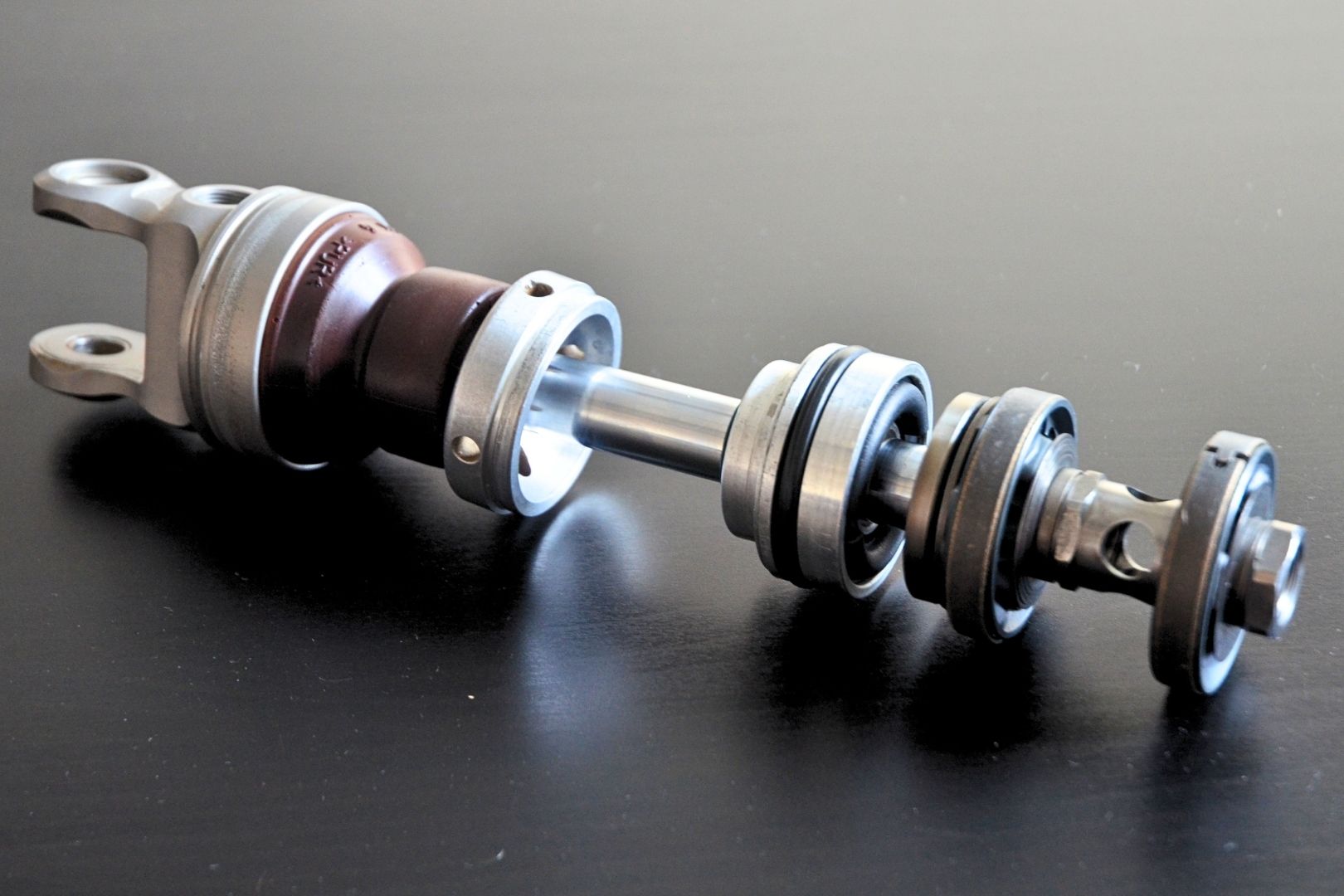
PDS throws the linkage away and asks the shock to do that job on its own. Instead of a single damping piston, it runs a twin-piston arrangement. As the shaft moves further into its stroke, a needle progressively engages the second piston, closing off the bypass increasing damping force. With the more recent designs, the piston enters the cup increasing damping force.
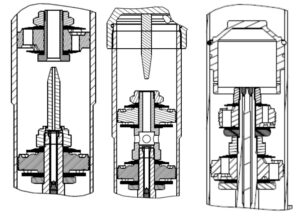
image from Tractive Suspension
The practical upshot:
- No linkage bearings to grease or wear out. Maintenance is close to zero beyond the usual shock service.
- Less weight. Ditching a full linkage assembly saves a few hundred grams.
- More ground clearance. With nothing hanging below the swinging arm, PDS bikes shrug off logs and rocks that could hook a linkage.
- Harder to tune. Generally the PDS designs don’t come anywhere near the kinds of progression found on the linkage bikes. Trying to find the correct balance can be difficult when the progression is so limited.
KTM has kept tweaking the over the decades, repositioning the shock lower in the frame around 2007–2008 to get more leverage and let softer, more effective progressive springs work properly, and continuing to revise valving and internals on what’s now sold as the WP Xplor shock.
Love it or hate it?
Riders have been arguing about this since the Jackpiner. The complaints are consistent: PDS bikes can feel like they sit up and extend on steep downhills (the so-called “stinkbug” feeling), and the shock can be harder to get truly plush without specialist tuning. The praise is equally consistent: it’s simple, light, low-maintenance, and gives you class-leading ground clearance for genuinely gnarly terrain.