You can’t tune what you can’t see.
What a shock dyno actually tells you.
A customer brought a shock in saying he’d recently bought a bike with an upgraded standard shock. His complaint was that it was far too hard, his assumption was it must be broken somehow.
The standard spring has been changed for a stiffer one, which isn’t helping, the only true way to see what the damping is doing is in the dyno.
The test process.
Pushing the shaft in by hand showed that there wasn’t anything untoward with the shock. The shock compressed smoothly with some resistance and extended smoothly with the gas pressure.
A manual check tells you whether a shock is catastrophically broken. It tells you nothing about whether it’s appropriate for the rider, the bike, or the use — and it tells you next to nothing about the adjustment range.
The adjusters were wound all the way out. The owner had been trying to get the shock as soft as possible. He’d found no meaningful difference. We were about to find out why.
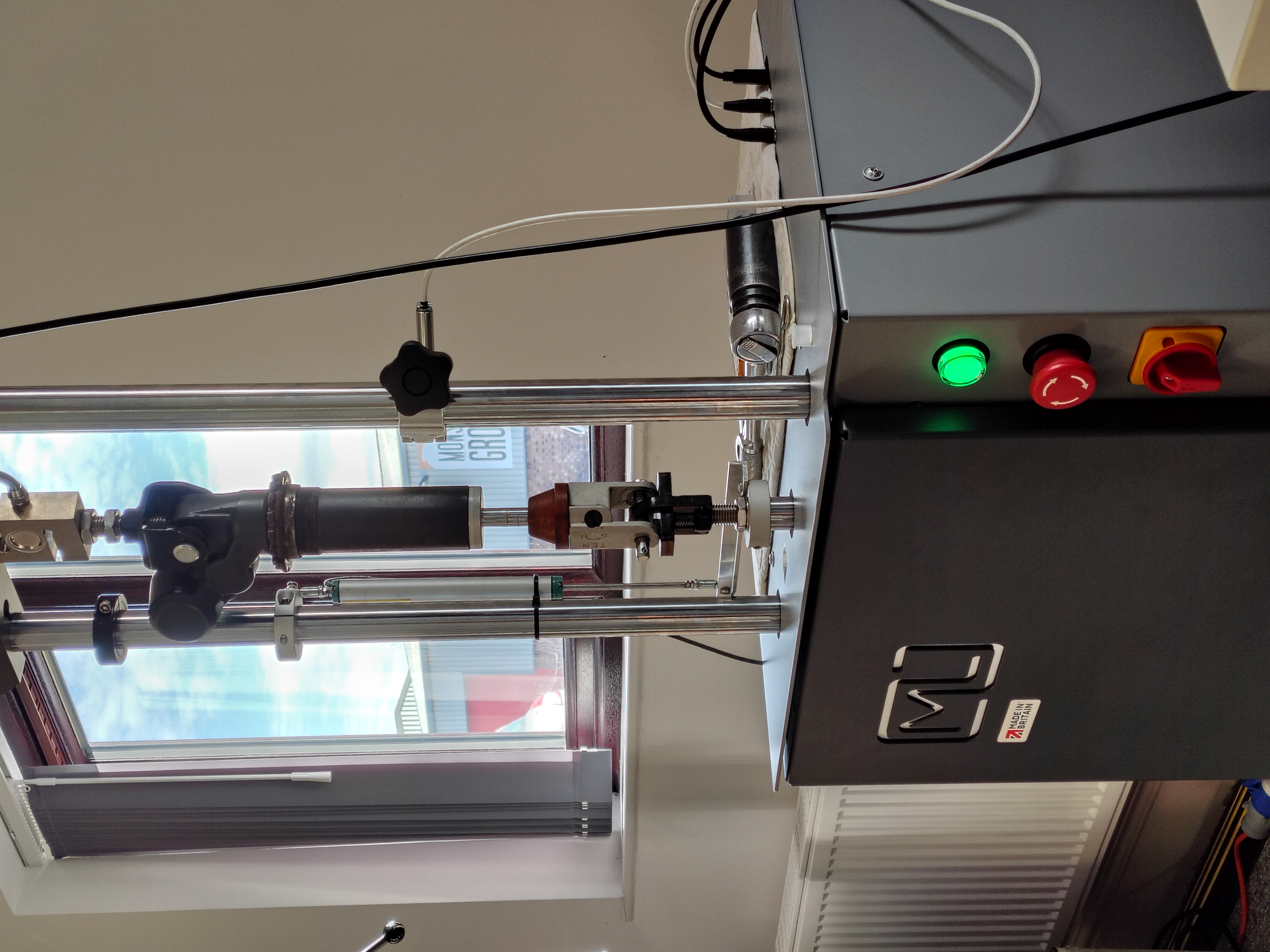
When we test shocks, we like to test them at ambient temperature first, which early this morning in the test room was 13 degrees. At this time of year the shock on this bike would get up to 40 degrees celsius, at most. The shock was cycled in the dyno up to above 40 degrees, left to heat soak, then another series of tests run, all at 40 degrees. The first run would be with exactly the same adjuster settings to show how much fade there was with temperature.
Test results.
Testing Cold:
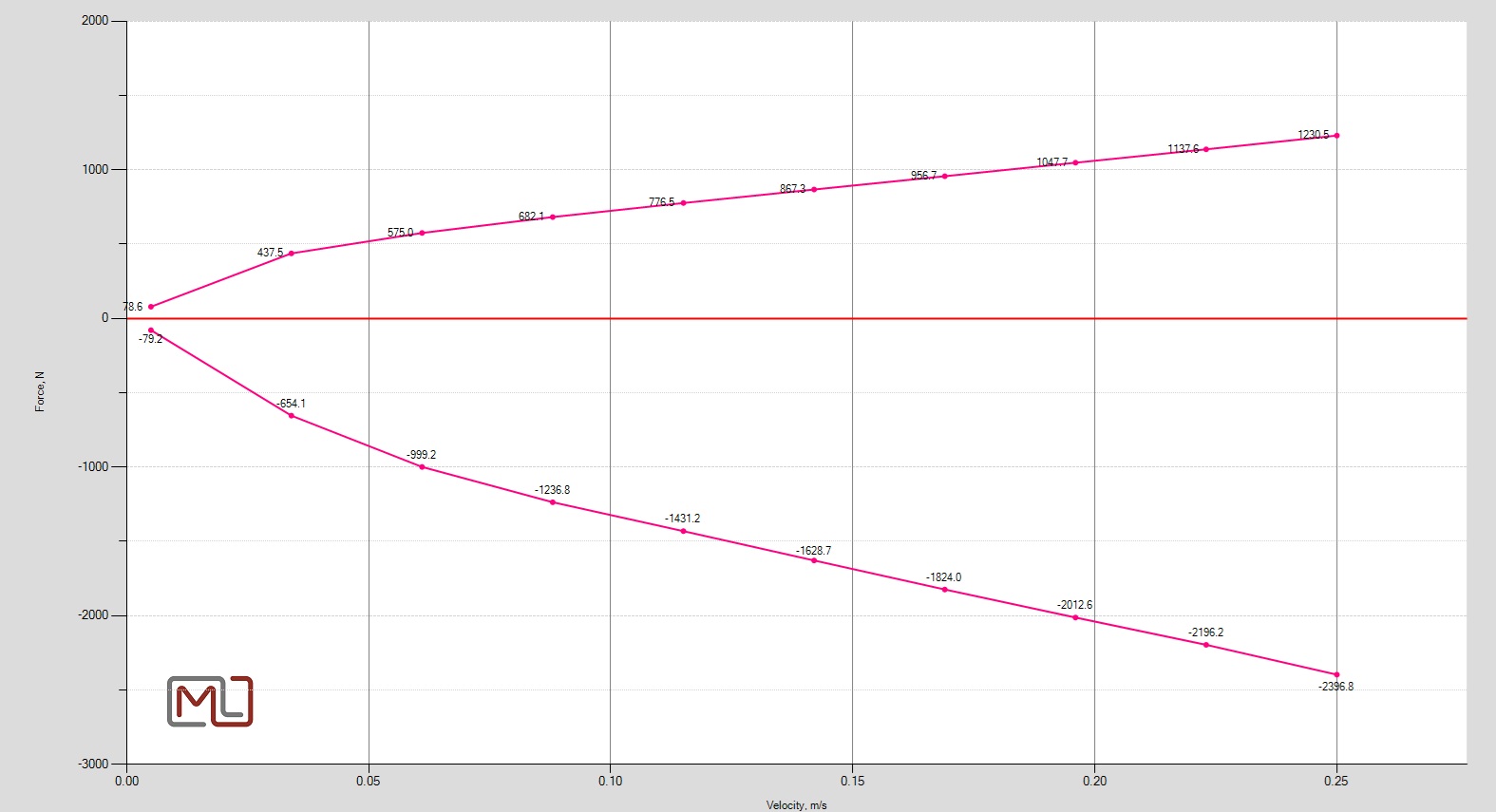
Testing the shock at 13 degrees shows a peak force at 0.25m/s of 2396N in rebound. A quick target to aim for at 0.25m/s would be 2540N, so it’s in the ballpark, within 6%, but the adjuster is wide open.
The big issue for a ride is the fact that the peak compression at 0.25m/s is around 50% of the rebound, at 1230N. At a really fast pace around a race track, this may work for some riders, but the rider is very much an amateur track day rider who isn’t put those kind of loads into the shock.
Testing Hot:
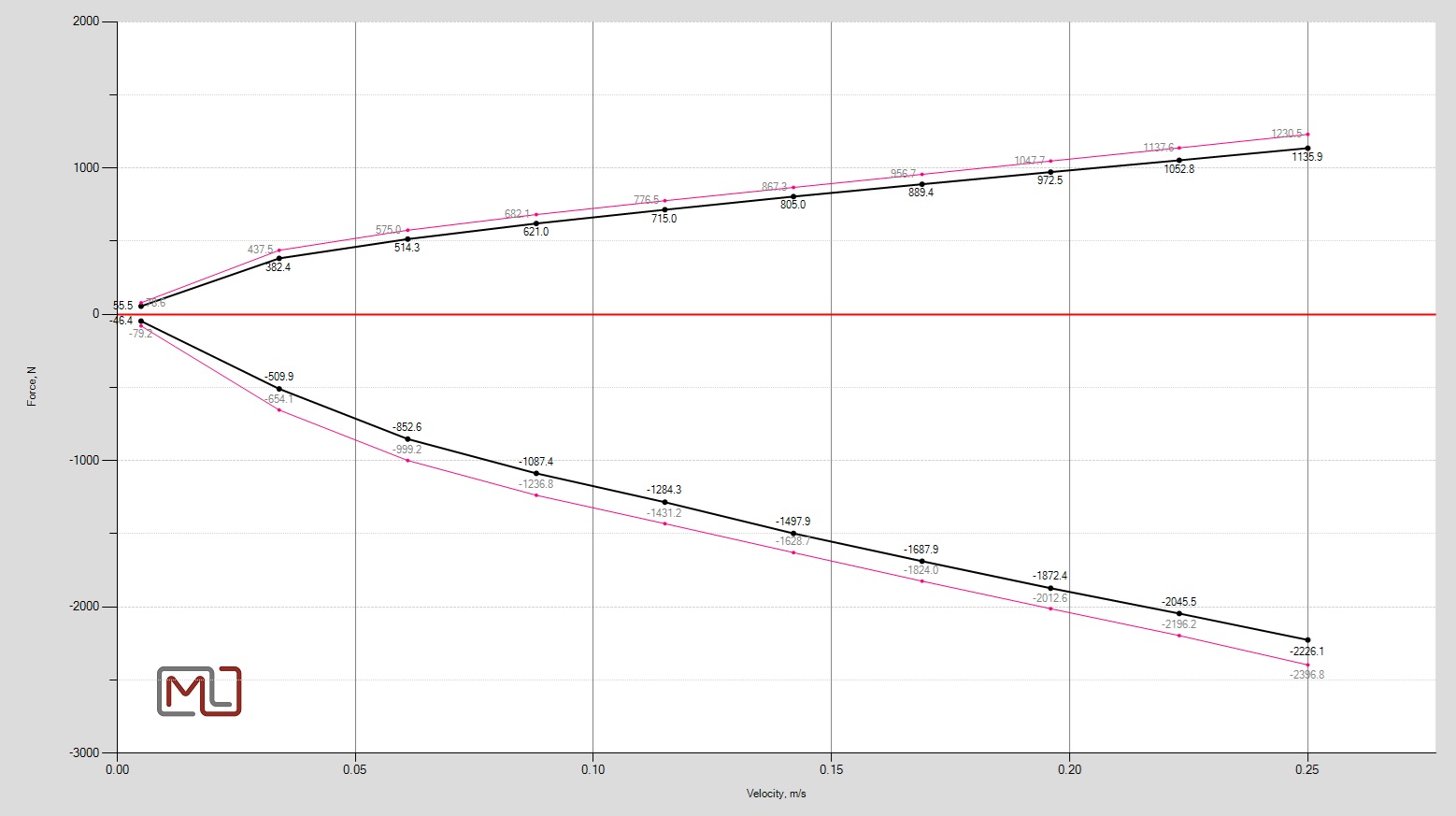
Running the shock at 40 degrees shows a drop off in force in compression and rebound. Normally the aim is to reduce fade as much as possible, and some stock shocks do fade badly, in this instance even fade is not coming to his rescue.
Testing the rebound adjuster.
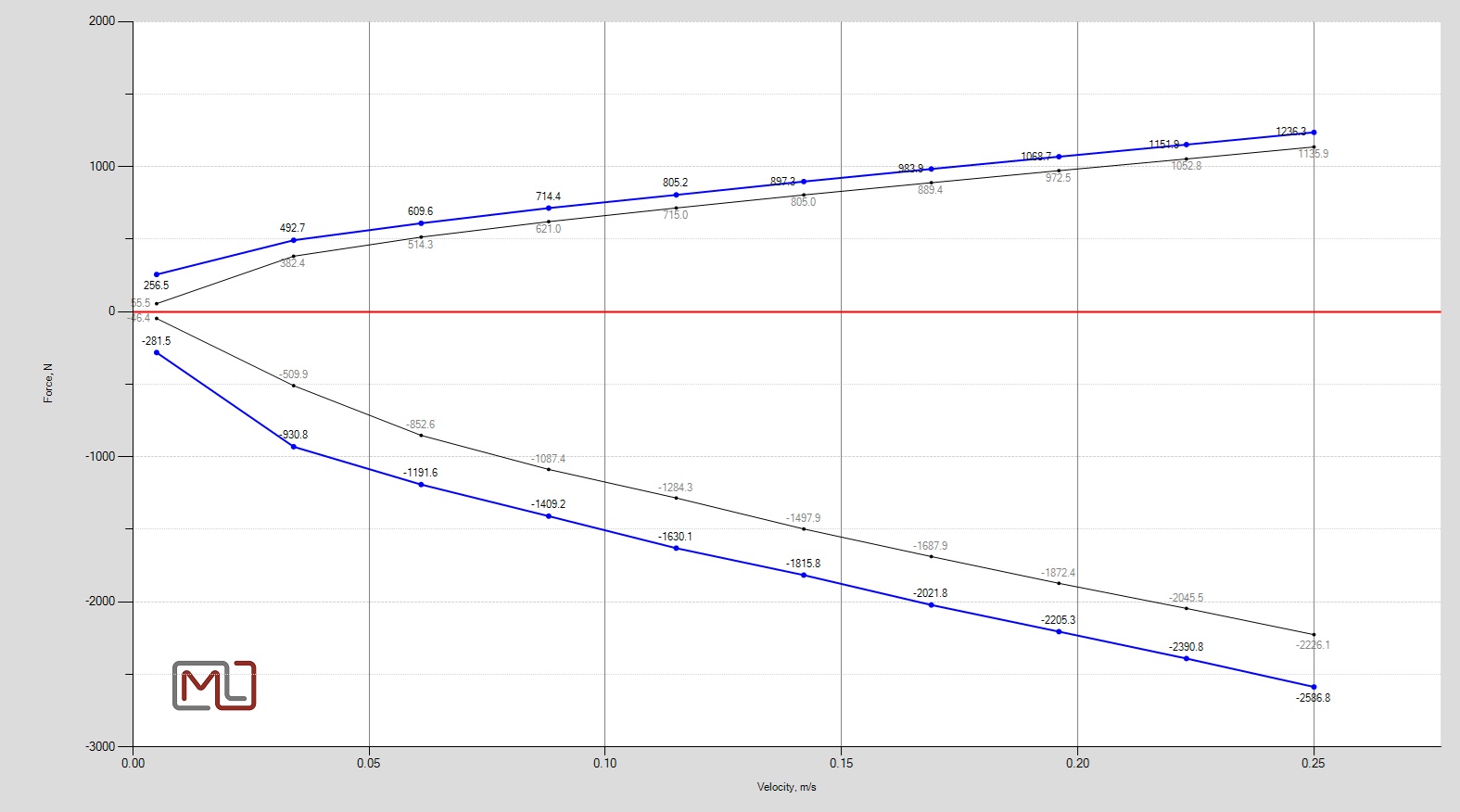
Screwing the rebound adjuster all the way in and then back out 1 click, shows the range of the adjuster. The graph shows that there is some cross over between the rebound and compression, with a big increase in compression at the slowest velocity and around 9% at the higher velocities. If he feels he needs more rebound adding more will make his compression problem worse.
There’s a good range of rebound adjustment at the lower velocities, diminishing to around 16% at the higher velocities.
Testing the compression adjuster.
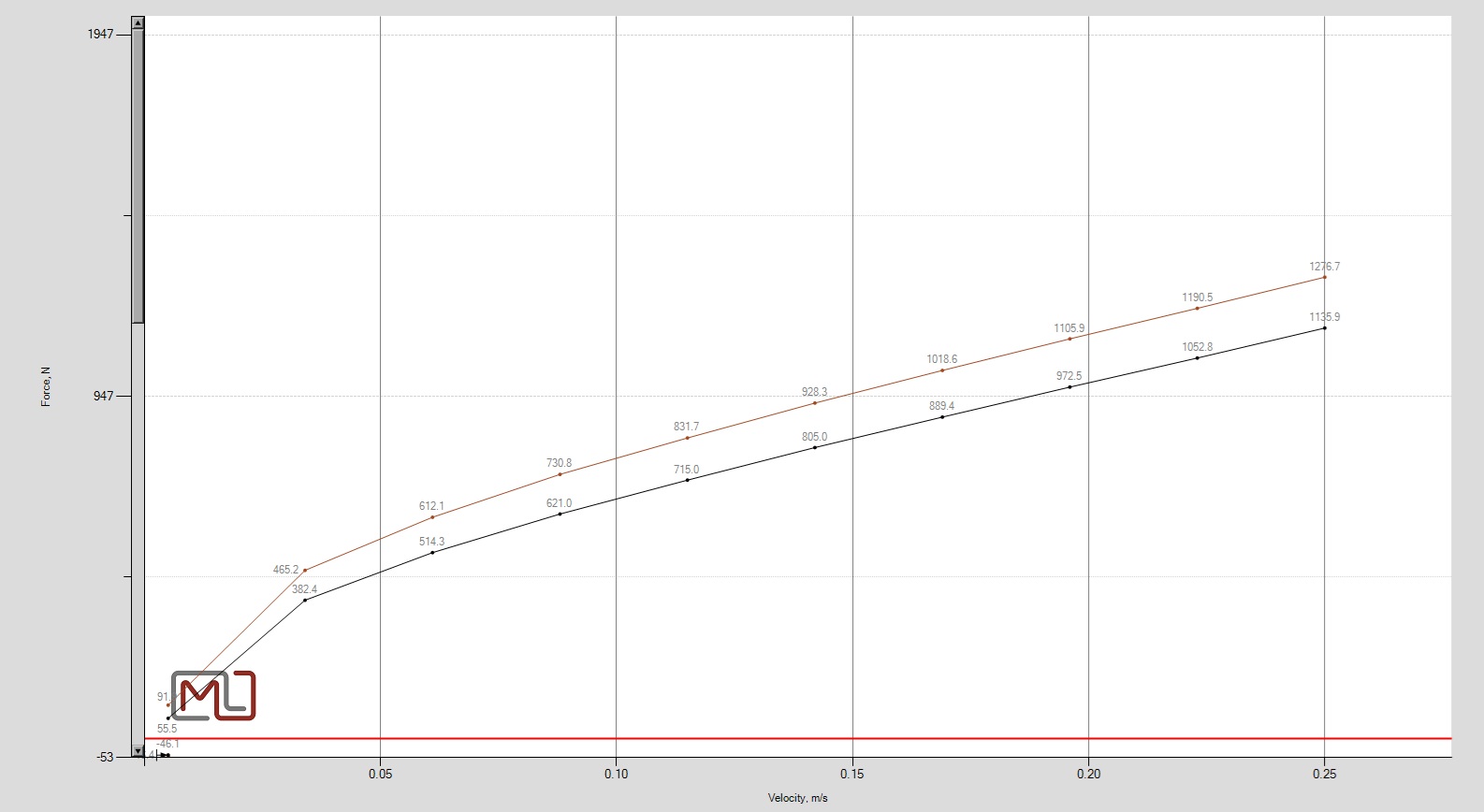
The rebound was screwed back out to test the compression range. The low speed compression was screwed all the way in, then back out 1/4 of a revolution. The high speed was screwed all the way in.
The scaling of the graph when zoomed in makes it look like a wide range, but in terms of a percentage increase, it’s not that big. A very sensitive rider may feel a 5% change, others 10%. At the very lowest velocities there may be a noticeable change for a sensitive rider, for the rest not so much.
In conclusion.
The data is showing us that the customer isn’t wrong in his interpretation of what’s going on. The dyno allows us to put numbers and hard data to the sensations he’s feeling.
The rebound is in the ballpark, but it’s at it’s softest setting, if he wants it softer, there’s nowhere to go.
The compression is way too stiff at it’s softest setting, so again he can’t make it softer. A more compliant action would have the compression at around 30% of the rebound, currently at it’s softest it’s 50%.
The Outcome.
This is exactly the scenario where a dyno stops the guessing. Without the data, the options are: keep adjusting and hoping, replace the shock and hope the new shock is softer, or tell the customer it feels fine by hand and send him away. None of those are good outcomes.
With the data, the conversation is clear. The shock isn’t broken, but the valving isn’t appropriate for him. The adjuster range is all working in the wrong direction.
Re-valving is the correct fix — and we can tell him exactly what we’re aiming for because we have the numbers we’re working from and the numbers we’re working toward.
That’s what a dyno is for.
Understanding what dyno data is telling you — how to read force-velocity curves, what adjuster crossover means in practice, and how to set targets for a specific rider and use are all part of the Motorcycle Suspension School shock dyno training.
for info on training
for info on dynos