Springs in Series and Parallel
Top-Out & Main Springs: The Common Mistake We See.
The Importance of Understanding Spring Interaction
Before making spring changes, consider whether your interpretation of how the springs function together is accurate. Misconceptions about spring dynamics can result in an ineffective set-up. A clear grasp of the physics involved can help avoid unnecessary changes and guide you towards a more balanced and responsive suspension.
Hookes Law states that Force = Spring rate (k) × Displacement (x) .
Springs in Series
If we take a single spring rated at 10 kg/mm, then a 10 kg load sat on top of the spring will compresses it by 1 mm.
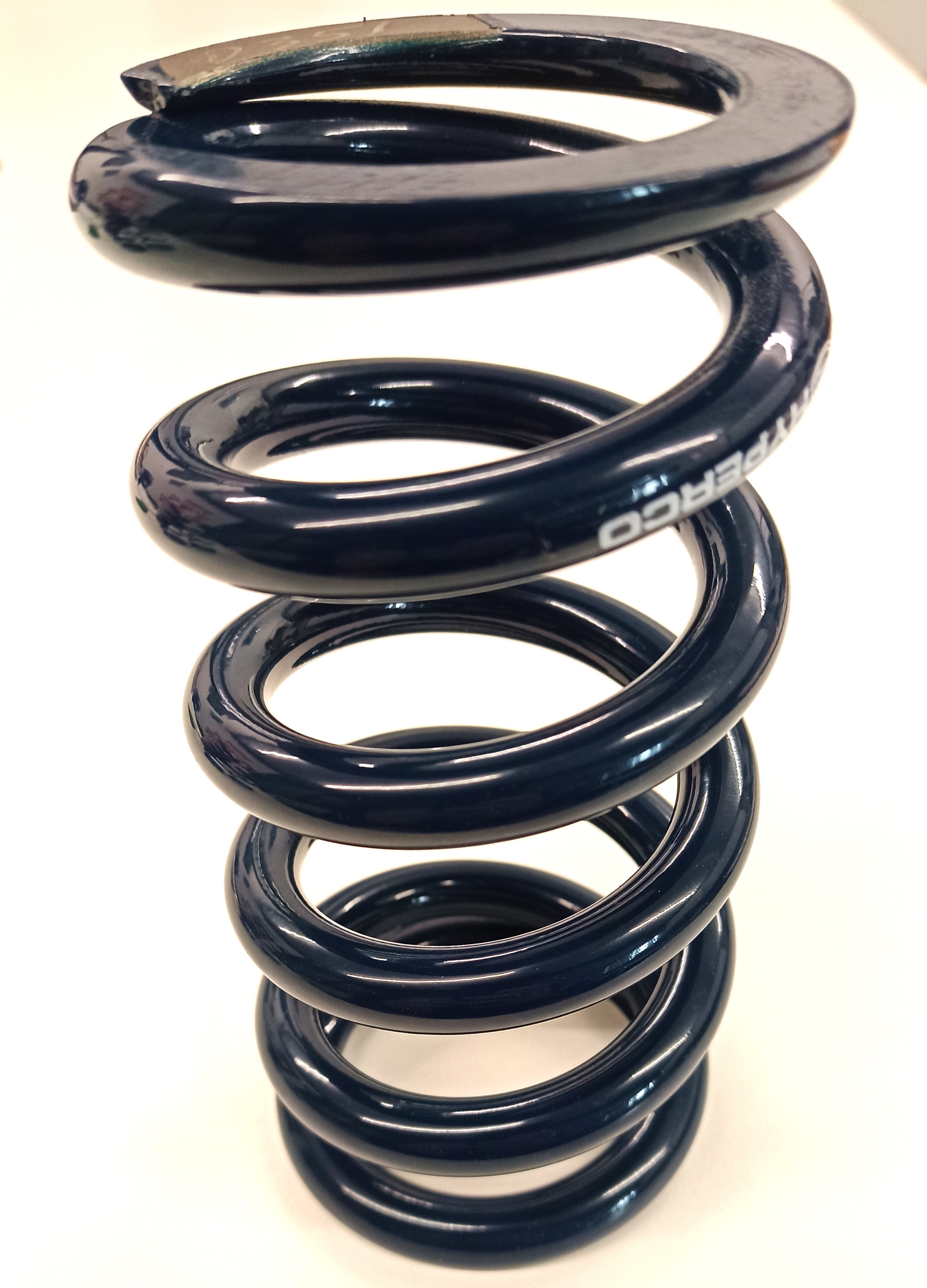
Stacking two identical springs in series and placing a 10 kg weight on top compresses each spring by 1 mm, resulting in a total displacement of 2 mm and a combined rate of 5 kg/mm.
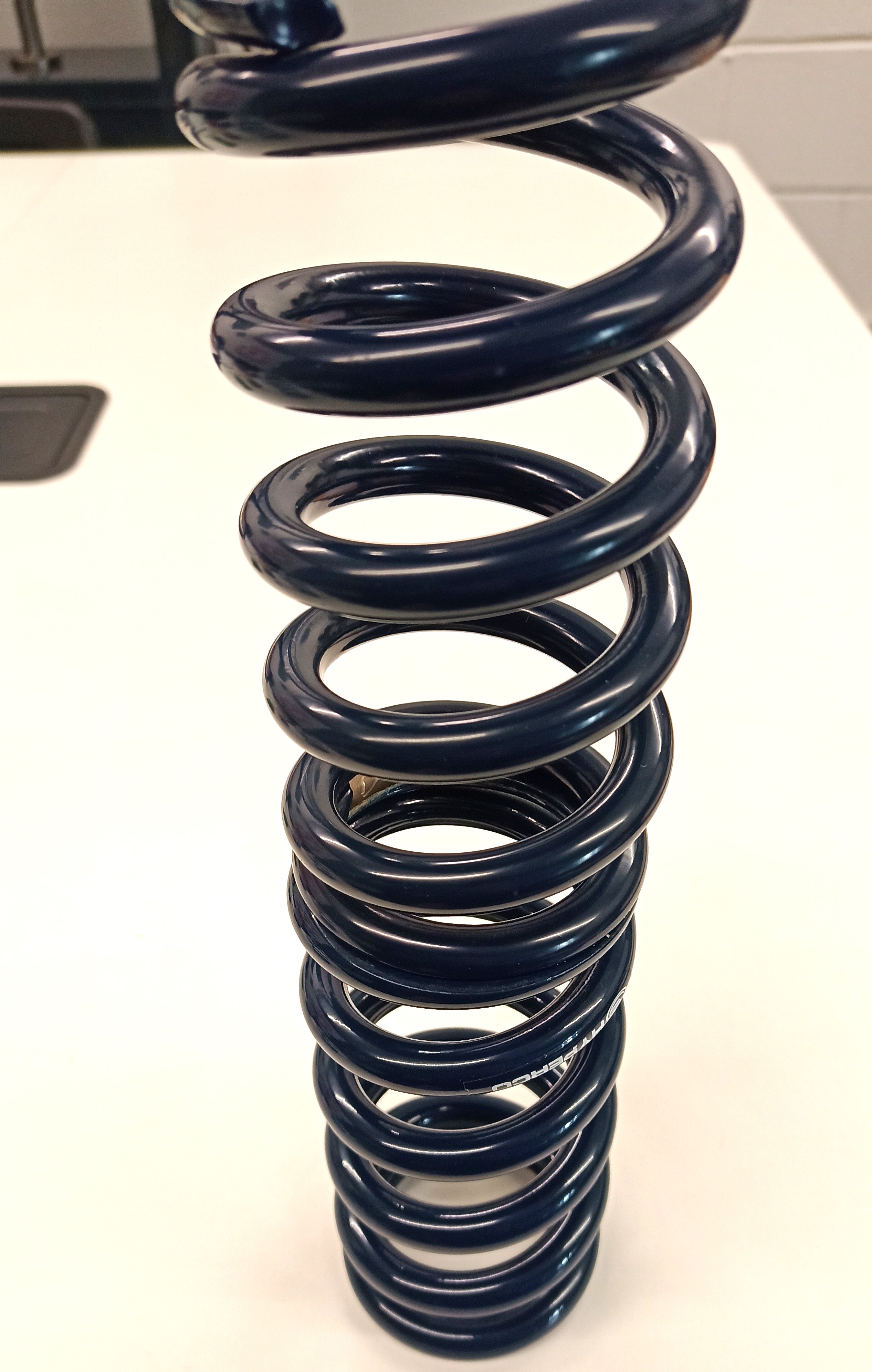
In the third example, I’ve stacked a 5 kg/mm spring on top of the 10 kg/mm spring. Under a 10 kg load, the softer top spring compresses 2 mm and the stiffer bottom spring compresses 1 mm, giving a combined rate of 3.33 kg/mm.
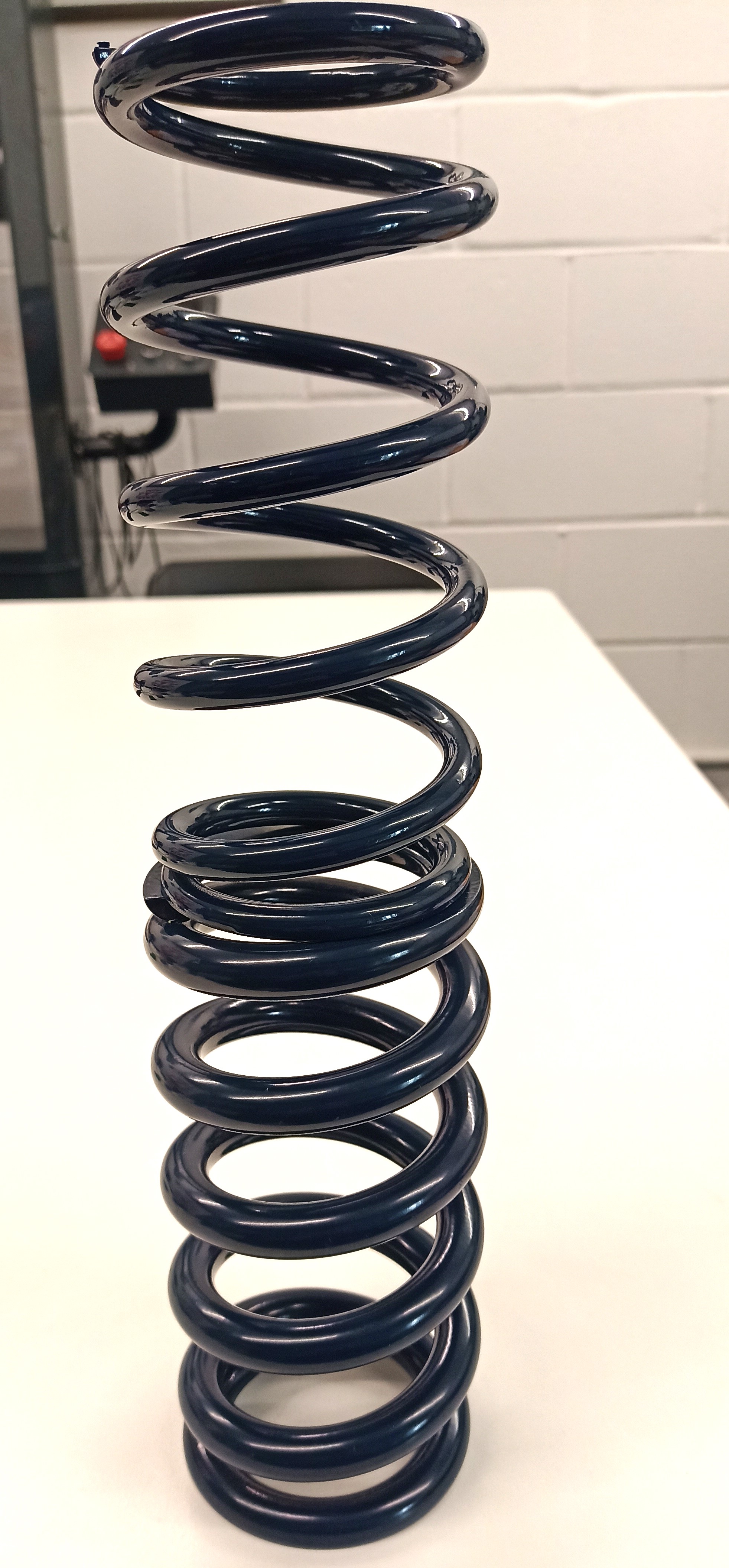
The formula for the combined rate of springs in series is: 1/kt = 1/k1 + 1/k2.. add as many springs as you like .
Tyres
This is one of the most argued points in suspension setup — and the maths is unambiguous. The tyre reacts to the load applied to it, not to what the spring above it is doing. If you’ve been adjusting springs trying to change tyre behaviour, you’ve been solving the wrong problem.”
Tyres are also a spring, if you apply a load to them, they compress; remove the load, they extend.
Looking at a motorcycle front fork, the tyre is a spring sat underneath the fork springs. The tyre and fork springs are springs in series.
I’ve heard a million and one arguments that say that if you go stiffer on the fork springs it will crush the tyre more, if you make the air-gap smaller, the spring effect will overload the tyre.. and so it goes on.
If we want to look at the tyre, then it functions as the bottom spring. Hookes Law tells us that for each spring the displacement is equal to the force divided by the spring rate. If we make the top spring extremely soft—say 1 kg/mm and keep the bottom spring at 10kg/mm —then under the same 10 kg load the top spring will compress 10 mm while the bottom spring still compresses 1 mm.
No matter what we do to the top spring, the bottom spring always reacts to the actual load applied. Using the formula for springs in series, the combined rate changes, but not the rate of each spring.
Forks are Progressive
Although a fork may use linear springs, its rate still becomes progressive because the air inside can be compressed. Compressing a gas results in a progressively increasing resistance.
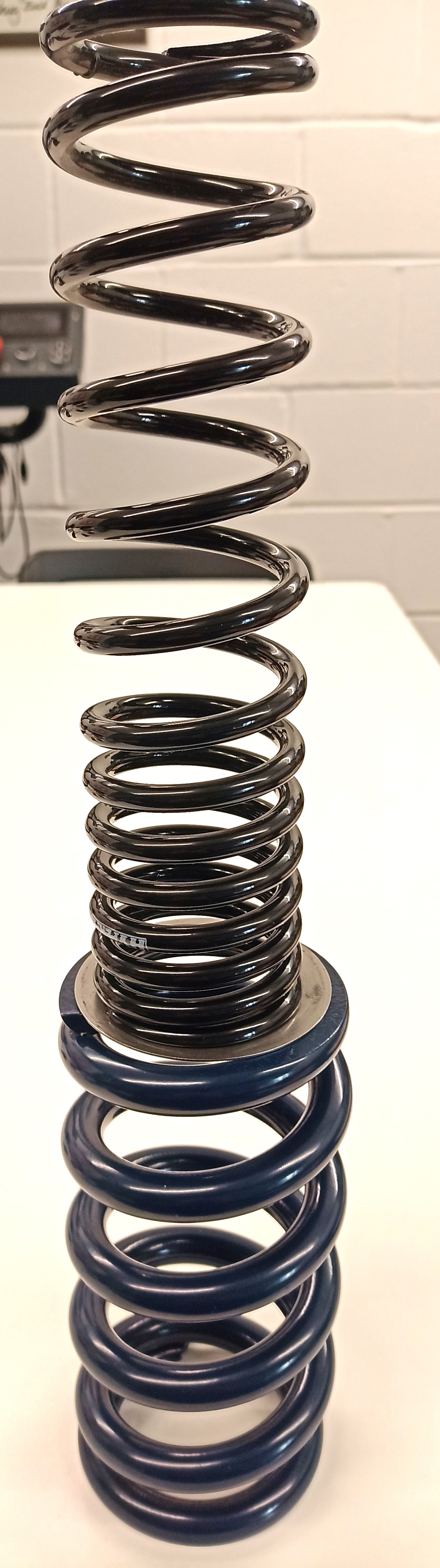
This image is a simplified representation of what happens in a fork and tyre system. The fork has a soft, progressive spring (air chamber plus coil) and the tyre acts as a much stiffer spring underneath. They behave as two separate springs in series. We can tune the fork spring however we like—softer means more fork travel, stiffer means less—but the tyre has its own rate and compresses according to the load, independent of what the fork is doing above it. The only way to change the deflection of the tyre is to increase or decrease the pressure inside.
Springs in Parallel
Another source of confusion seems to be springs in parallel.
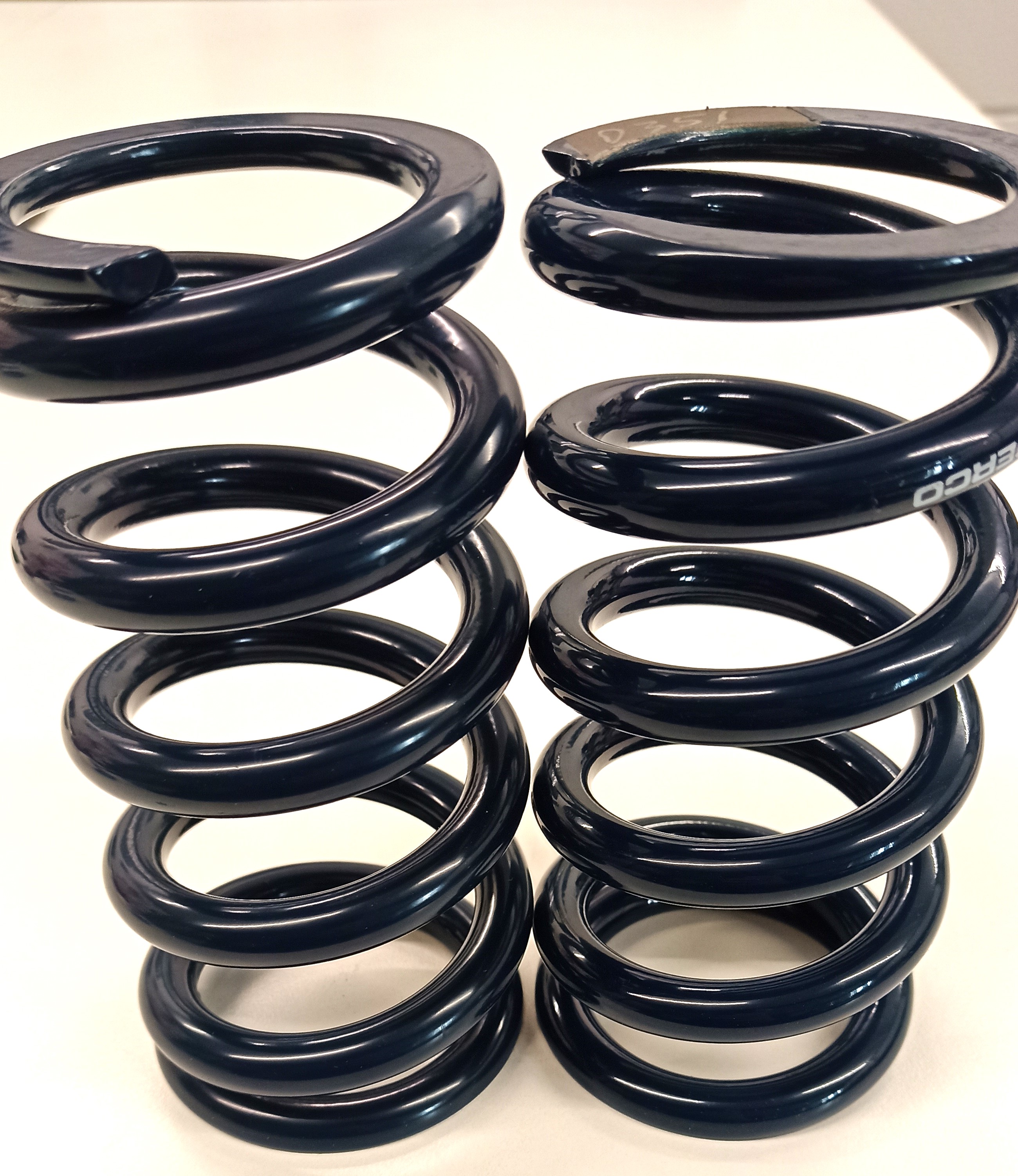
With two springs of the same rate sat side by side, the combined rate doubles. In a fork if you have a 1kg/mm spring in each leg, the overall rate is 2kg/mm. You could mix rates, have a 1kg/mm in one leg and a 0.95 in the other, giving an overall rate of 1.95kg/mm. In the motorcycle world it would be common (widely understood) terminology to refer to that as a 0.975 kg/mm rate as it acts like a 0.975 rate in each leg.
Top out Springs
Top out springs are where the real confusion lies. Time and time again I see people get it wrong.
TOP OUT SPRINGS ARE SPRINGS IN PARALLEL!
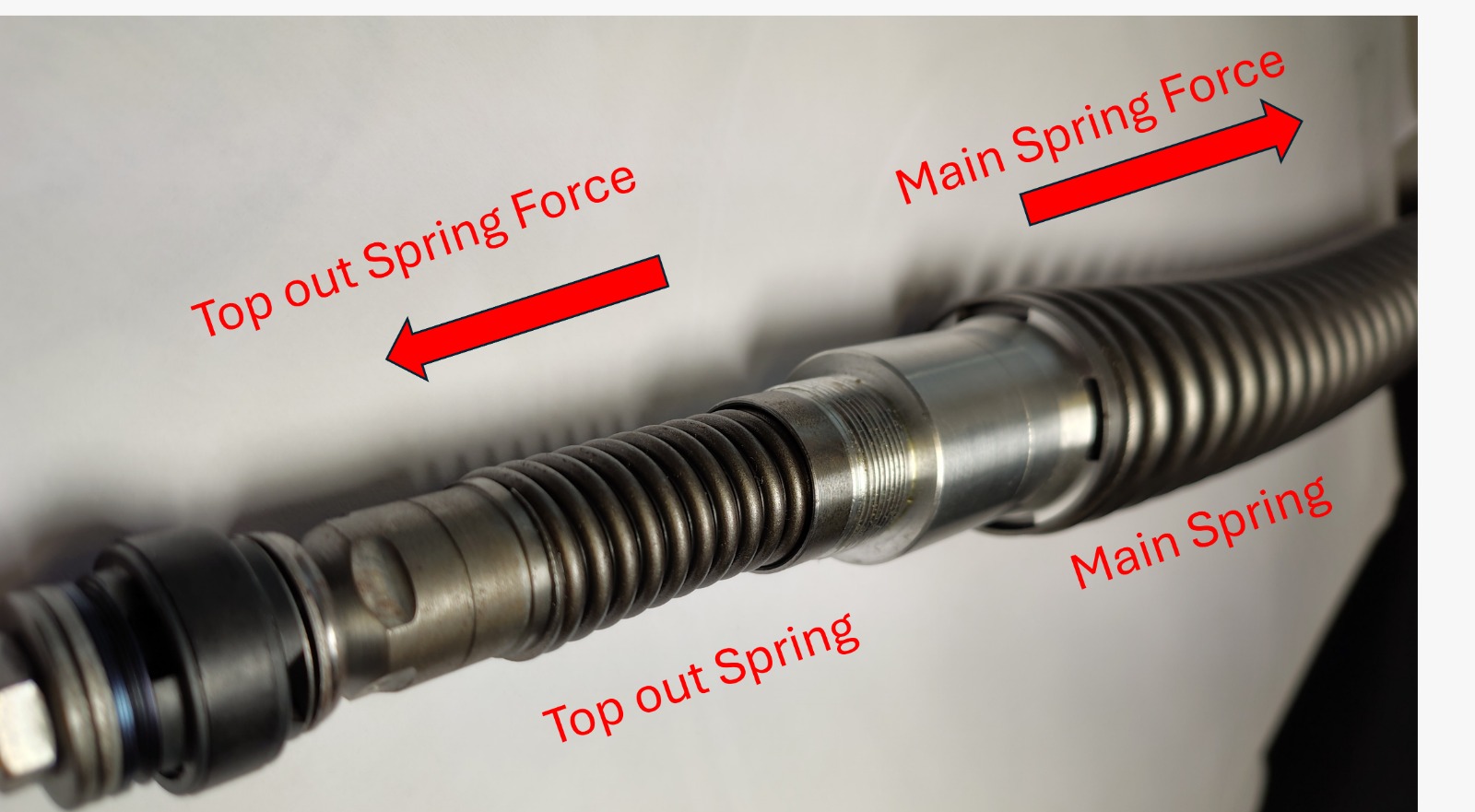
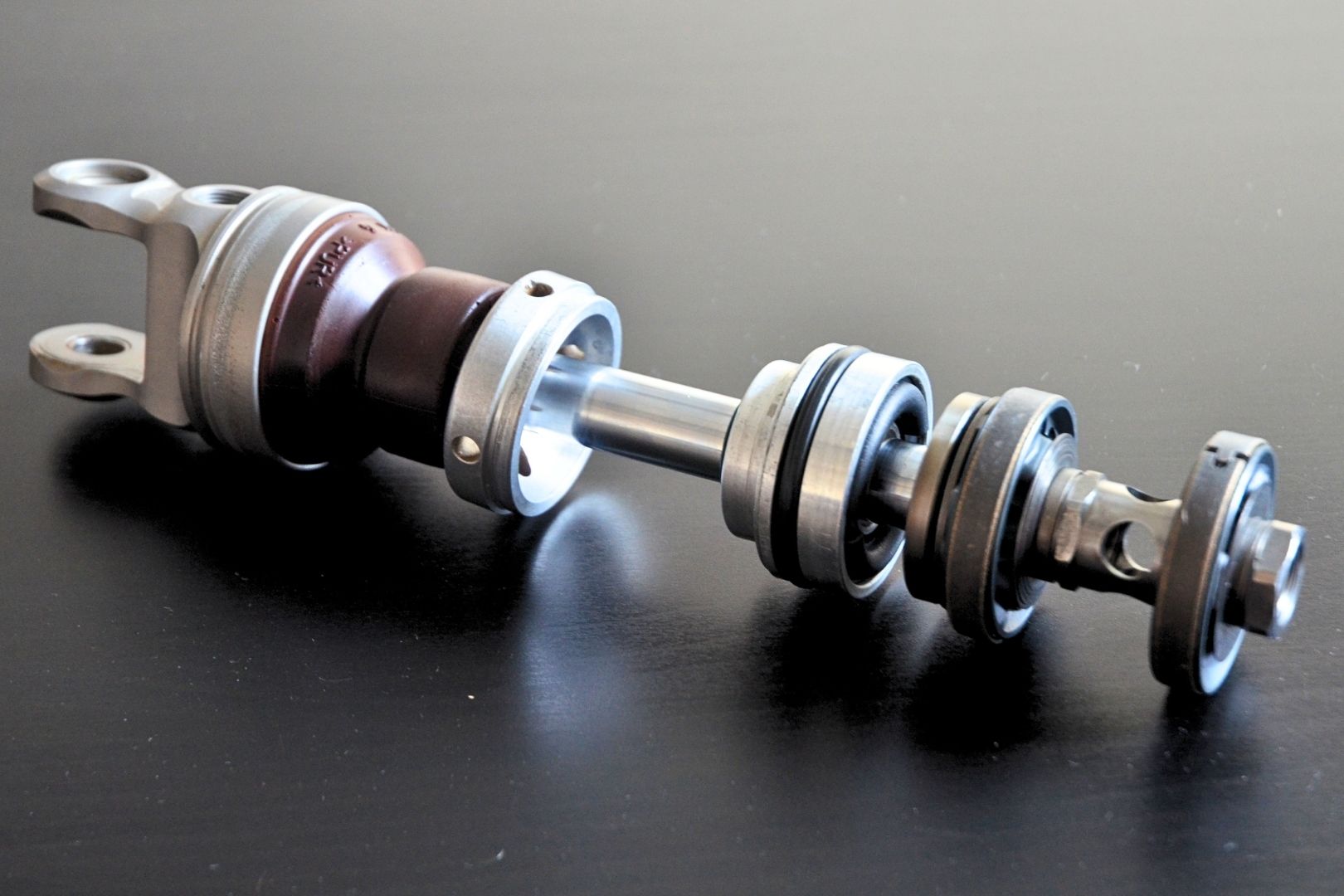
The image shows a prop we use in the school, it’s the rod out of a fork cartridge. It has the rebound piston at one end with a top out spring, and the main spring at the other end. In the centre of the image is the threaded cylinder head that screws into the cartridge.
The rod is fastened at the end in a way to preload the main spring. Preloading the main spring, also preloads the top out.
The top out spring force is acting on the rod, trying to push it to the left. The main spring is acting on the rod trying to push it to the right. At the point shown, the stored forces in each spring are equal, the rod isn’t moving.
By holding the cylinder head securely the rod can be pushed to the left. If we push it, the main spring compresses and the top out spring extends. The force from the main spring is pushing against us, but the force from the top out spring is pushing with us. Therefore the overall force that it takes to move the rod is the force from the main spring acting against us, minus the force from the top-out spring acting with us. Having the top out means that it takes less force to move the rod than it would if it wasn’t there. (assuming the same main spring and preload)
The misunderstanding relates to the spring rate. Spring rate is about how much the force changes as the spring moves.
Making the numbers simple again, if the spring rate of both is 1kg/mm, the main spring will compress at a rate of 1kg/mm and the top out spring will extend at a rate of 1kg/mm. Even though the top-out spring reduces the total force needed at any given position, both springs are still changing force by 1 kg/mm as the rod moves. The two rates therefore add together, giving a rate of change of 2kg/mm.
The key point is:
It takes less force to start moving the rod, but the force increases more quickly as it moves.
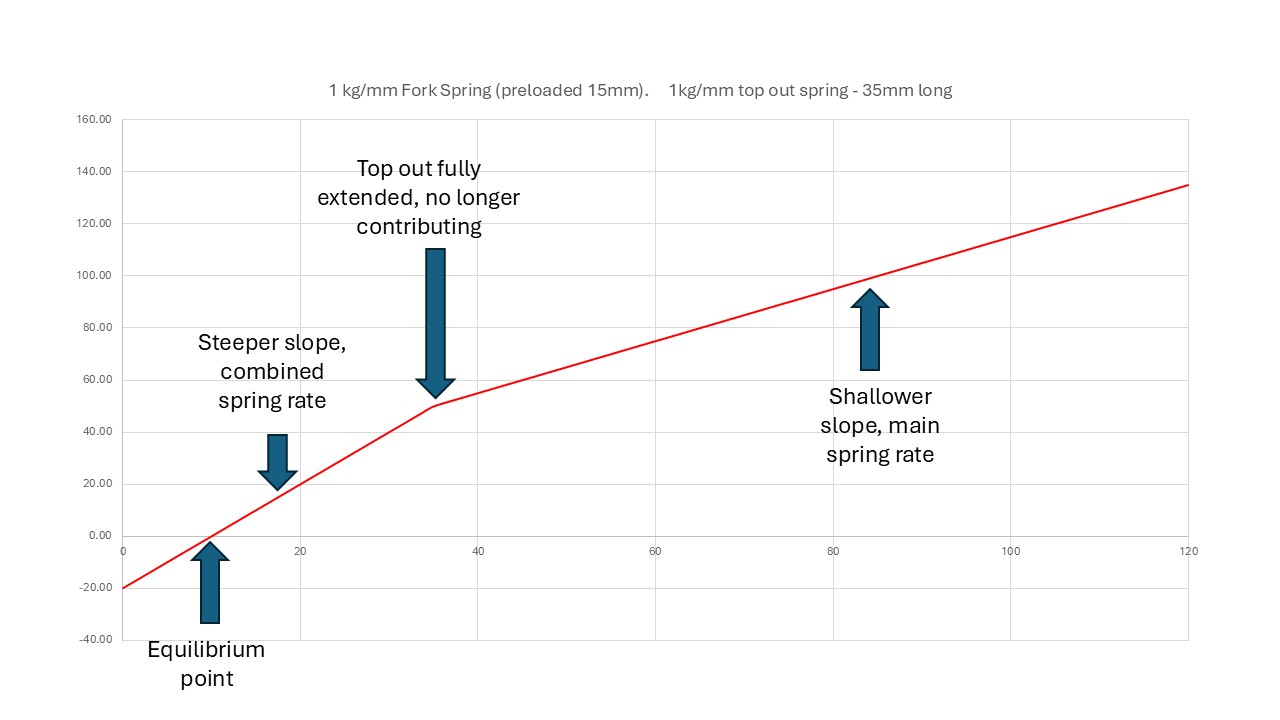
Graphing the force out shows the lower initial force, but with a steeper slope from the combined rate. The top-out is 35mm long, so once it’s fully extended it’s no longer doing anything. At that point the slope of the graph falls as the main rate takes over.
Comprehending rate behavior is one aspect; however, selecting, preloading, and properly considering top-out springs requires additional expertise.
The fundamentals of spring systems are covered during our Master Technician Course.
Details on the course can be found at:
https://www.suspensionschool.com/