Load Cell Range and Accuracy
What “Accuracy” Actually Means on a Load Cell Datasheet
Here’s the thing that trips people up. When a load cell manufacturer lists accuracy as a percentage, say ±0.011%, that percentage is not of the reading. It is a percentage of the full-scale output of the sensor.
This is an important distinction. A ±0.011% accuracy spec on a 15 kN load cell does not mean your measurement at 100 N is accurate to ±0.011 N. It means the error at any point in the range could be as large as:
15,000 N × 0.00011 = ±1.65 N
That is a total potential error band of 3.3 N, regardless of whether you are measuring a 100 N load or a 10,000 N load.
Now apply a slightly less precise sensor, say ±0.017% full scale, which is still a respectable, commercially available spec:
15,000 N × 0.00017 = ±2.55 N
You are now looking at a 5.1 N error band on every measurement. Every single one.
Why This Matters for Fork Springs
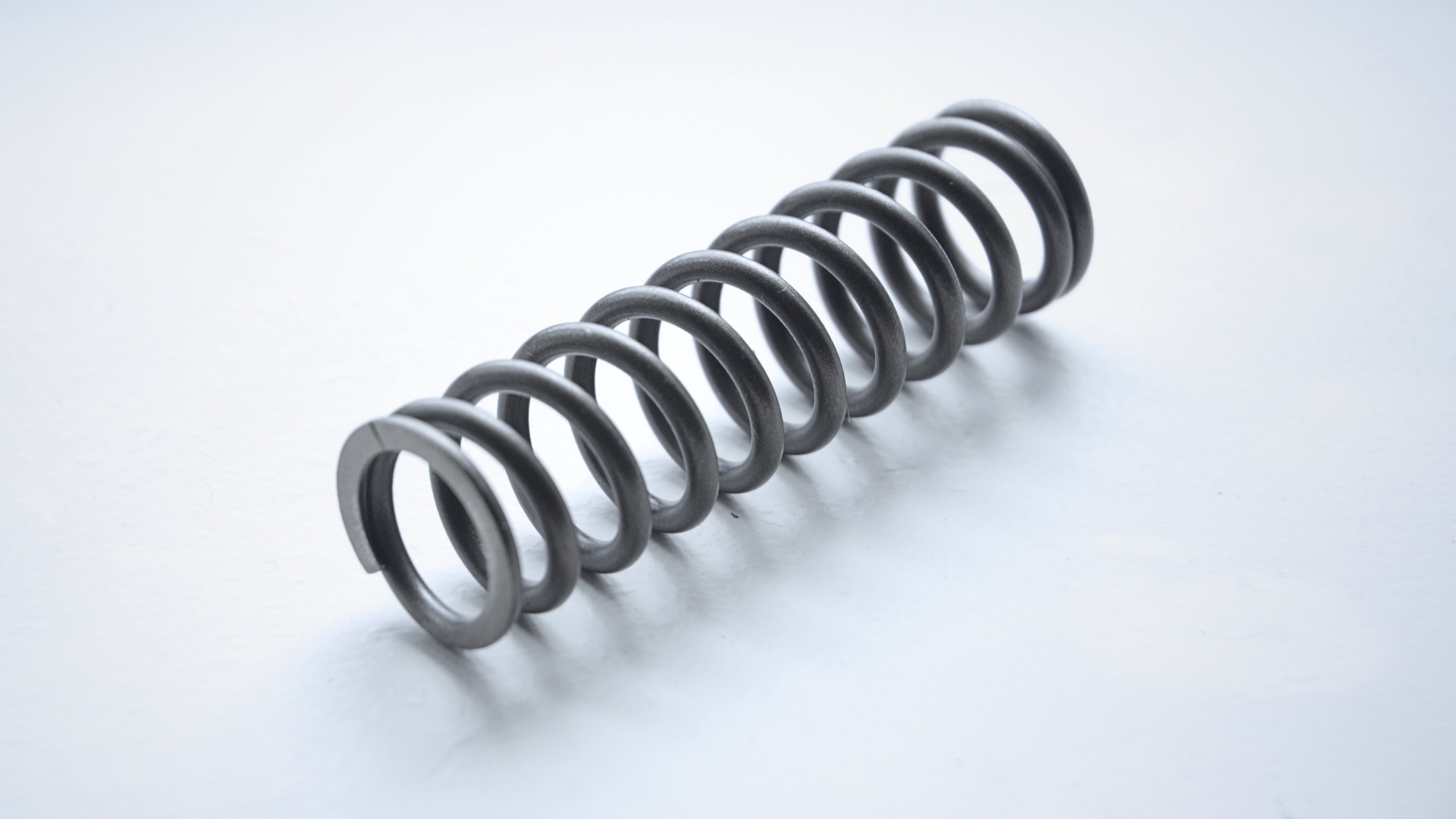
Fork spring rates, particularly for off-road applications, are often in the range of 3–8 N/mm. If you are testing a spring by loading it through a known displacement and measuring the force, you need to resolve force differences that are a fraction of a newton per millimetre of travel to get a meaningful spring rate figure.
When your measurement instrument has an inherent uncertainty window of ±1.65 N to ±2.55 N, you are not measuring fine increments, you are guessing within a band. The instrument may display a precise looking number to two decimal places, but that precision is not accuracy. The display resolution and the sensor accuracy are completely different things, and manufacturers of lower-end testers are not always eager to draw your attention to the gap between them.
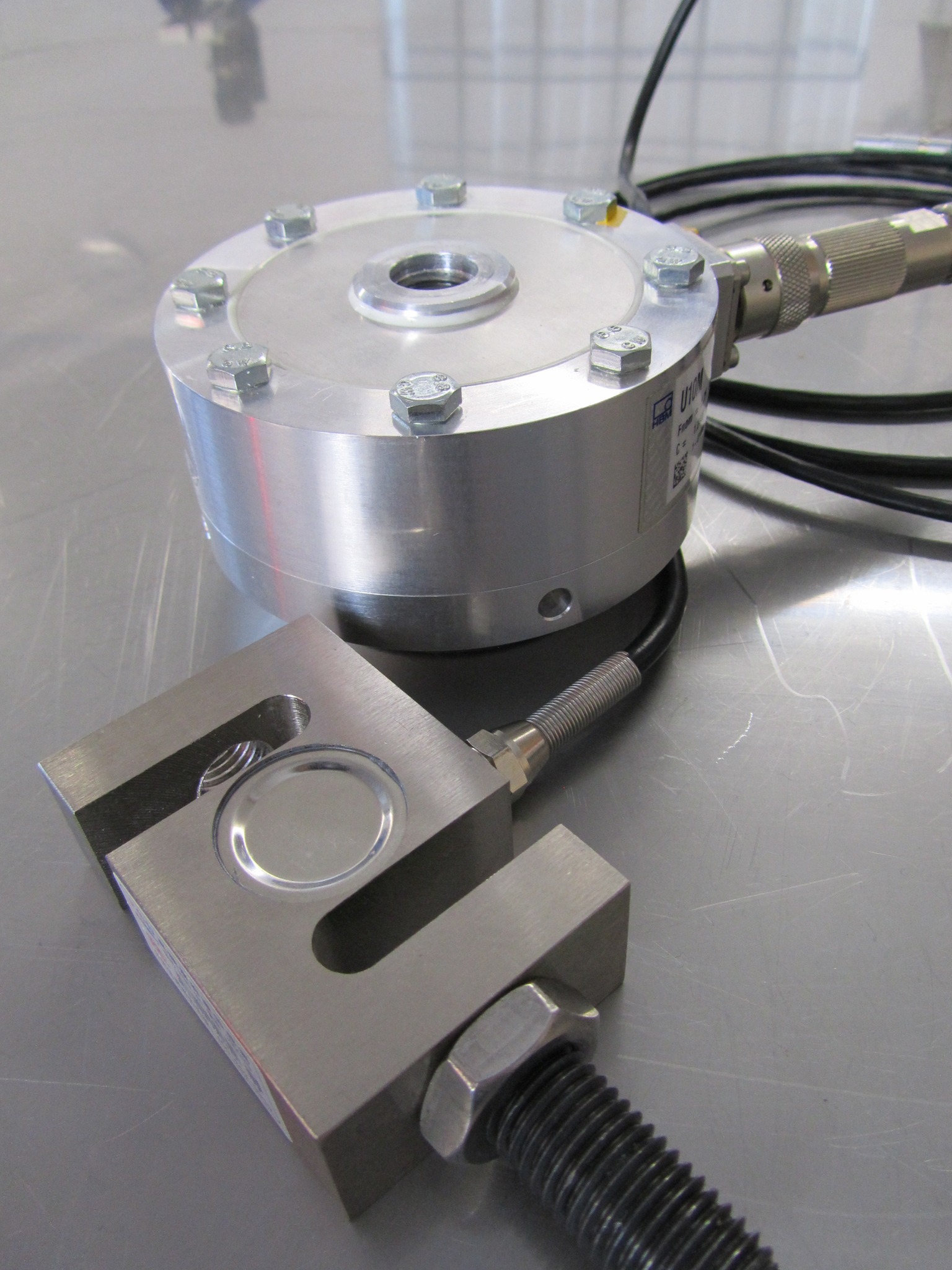
Let’s run the numbers for the common load cell sizes you will see offered on spring testers:
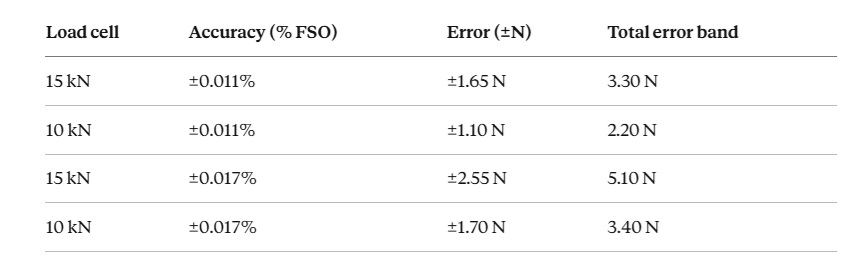
For testing heavy shock springs where loads run into the thousands of newtons, a 10 or 15 kN cell with a good accuracy spec is perfectly adequate, the error is small relative to the forces involved.
For fork springs, particularly soft off-road units, it is not adequate. The error band alone may exceed the difference between two spring specifications you are trying to distinguish.
What You Actually Need
To test low-rate springs with meaningful precision, you need a load cell with a much lower full-scale range. A 500 N or 1 kN load cell with the same ±0.011% accuracy spec gives you:
1,000 N × 0.00011 = ±0.11 N
That is a 0.22 N total error band, more than an order of magnitude better than the 15 kN cell, and actually fit for purpose when measuring the fine load-deflection behaviour of a fork spring.
Some spring testers on the market offer interchangeable load cell options for exactly this reason. Others come with a single fixed cell, usually sized for the maximum load the machine can apply rather than for the load range where precision matters most. If you are evaluating testers, ask specifically what load cell range is fitted and what the full-scale accuracy specification is. Do not accept “high accuracy” as an answer, ask for the number.
The Calibration Caveat
All of the above assumes the sensor was calibrated correctly in the first place, and that calibration is maintained. A load cell that was accurate when it left the factory but has not been verified since is not a calibrated instrument, it is a load cell that was once calibrated. Creep, overloading, temperature cycles, and mechanical shock all affect sensor behaviour over time.
If you are making purchasing or setup decisions based on spring tester data, it is worth asking when the machine was last calibrated against a traceable reference standard, and what that calibration record looks like. A tester with a modest but well-maintained and regularly verified load cell will give you more trustworthy data than a tester with a high-specification cell that has never been checked since it was built.
The Summary
The marketing around spring testers often emphasises load capacity, how much force the machine can apply, because that is a simple, impressive-sounding number. Accuracy is more nuanced, and the full-scale output basis of percentage accuracy specs means that a large-range load cell is inherently less precise in absolute terms than a smaller one with the same percentage spec.
If you are testing fork springs or other low-rate components and you care about the result, match the load cell range to the load range of interest. A machine that can test everything from fork springs to clutch springs in a single setup sounds convenient, but if it does so with a single large-range load cell, it is making a compromise you should be aware of before you trust the numbers it gives you.
The maths here is not complicated. Full-scale accuracy times full-scale range gives you the absolute error. Check the spec sheet, check the range, check when it was last calibrated.